Landing in Singapore and the hotel.
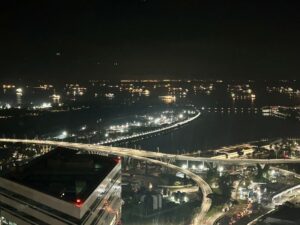
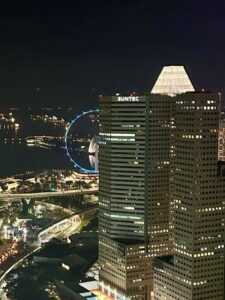
This was a pre-retirement trip in November 2025. Upon landing in Singapore, we grabbed a taxi directly from the airport terminal to head to our hotel. The fare was very reasonable, and there was no waiting line. My daughter, who lives in Hawaii, flew in to join us for this leg of the adventure. We stayed at the Hyatt Andaz Singapore. Because I hold Hyatt Globalist status, I used my Hyatt Suite Upgrade Awards and both of our rooms were automatically upgraded to beautiful two room suites. The Andaz is an excellent, highly convenient property featuring a direct subway link and an attached shopping mall right in the basement at the Bugis MRT station. On our first evening, we enjoyed drinks at the hotel’s rooftop bar, which offers a stunning panoramic night view of the Singapore skyline.
Now, let’s get to the good stuff! The destinations I explored were:
Quick Guide
- The Battlebox
- Bunker Layout and Working Conditions
- After the Surrender
- Visitor Tips and MRT Directions
- Further Resources
- The Battlebox: An underground command bunker hidden inside Fort Canning Hill.
- Fort Siloso: A preserved coastal artillery fortification on Sentosa Island.
The Battlebox
The Battlebox was constructed between 1936 and 1939, reaching operational readiness by 1941. It served as the primary subterranean headquarters for the defending British and local forces during the grueling Malayan Campaign, which raged from December 8, 1941, to February 15, 1942.
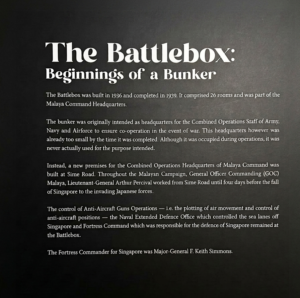
Buried 30 feet beneath the surface of Fort Canning Hill, this highly classified, bomb-proof facility featured reinforced concrete walls a full meter thick to survive direct artillery and aerial bombardment. It acted as the vital nerve center for the British defense of Singapore. It was inside these tense underground rooms that Lieutenant General Arthur Percival and his senior commanders faced their final hours before signing the surrender paperwork on February 15, 1942.
On the eve of the surrender, British personnel burned top-secret operational documents and communications records inside the bunker to deny intelligence to the enemy. Because the complex had been constructed entirely by British military personnel under military secrecy, no architectural blueprints or structural layouts were left behind for the local population.
Layout and Working in the Battlebox
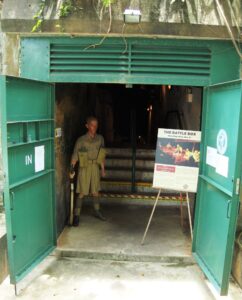
The Battlebox has narrow corridors today, it’s hard to imagine how hundreds of military personnel survived the stifling, non air-conditioned heat while the Japanese heavily bombarded Fort Canning Hill. Since there were no barracks officers and staff slept in cramped, rotating shifts inside tiny sleeping cubicles. The air was perpetually thick, humid, and smelled of sweat, stale tobacco, and anxiety. The Battlebox was designed to last in isolation for one two weeks with generators, water, military rations, but even then had external mechanical pumps for air and even filters for poison gas. Security was tight and there were fortified guardrooms and detention cells.
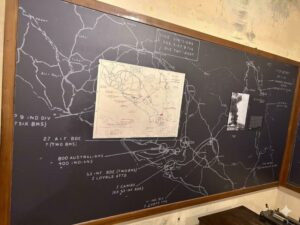
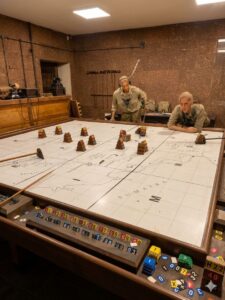
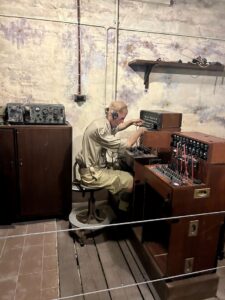
The Battlebox included rooms for several functions, Command & Tactical Core which had a large plotting room with maps tracking movement across Malaya. The operations room where senior staff read intelligence reports and developed field orders. General Percival had his own office and meeting room. A Communication & Intelligence section with a restricted entry to the cipher office and a Signals room which housed telephone operators managing lines across the entire peninsula.The mechanical room included generator, air-filtration ventilation machinery plants (No A/C, just pumped air). Finally, there were cramped sleeping quarters and latrines.
After the Surrender to Japan
Following the capitulation, the Japanese military occupied Singapore for three and a half years (1942–1945). They utilized the Battlebox as a regional military communications hub right up until Tokyo’s unconditional surrender in August 1945. The facility also housed guardrooms and security detentions. Suspecting that valuable military equipment, currency, or gold might be hidden within the structure, Japanese forces excavated sections of the bunker floor.

After the War
In the immediate aftermath of the Japanese surrender in 1945, local civilians entered the unprotected complex and thoroughly looted it for remaining valuables. The British military subsequently returned to Fort Canning Hill to establish their Singapore Base District Headquarters. However, while they actively utilized the above-ground colonial buildings, the subterranean bunker was completely ignored and left to decay.
Post-War Abandonment and Rediscovery
When British forces officially withdrew from Singapore between 1968 and 1969, they handed the grounds over to the Singapore Armed Forces. Citing severe structural issues and safety hazards, authorities chose to brick up the entrances. Over the subsequent decades, dense tropical vegetation swallowed the entryways, and the facility vanished from public memory.
The bunker re-entered history in February 1988 when research by journalist Romen Bose tracked prompted authorities to clear away the vegetation. His investigation unearthed historical clues pointing to a forgotten underground headquarters. Teams cleared away the jungle overgrowth and breached the bricked-up doorways to survey the interior. Aside from the skeletal remains of a dog that had accidentally been locked inside decades prior, the rooms had been entirely stripped bare.
The Singapore government launched a meticulous restoration project to rebuild the wartime layout. Using declassified records and interviews with veterans, historians recreated the rooms to match their exact February 1942 appearance. The restored site officially opened as a museum on February 15, 1997—a launch date deliberately chosen to mark the 55th anniversary of the British surrender.
Visitor Tips
The Battlebox is managed by the non-profit Global Cultural Alliance. Basic entry to the bunker is entirely free, but slots are highly limited. You are strongly encouraged to book your tickets online well in advance. I reserved my slot before arriving, which was fortunate as the site was completely booked for walk-ins when I got there.
While general admission is free, you can pay a fee on-site to unlock the Enhanced Experience. A 270 degree projection room which displays British and Japanese tactical positions on a map (using the 3D glasses). This includes a 40-minute smartphone-guided audio tour, access to two specialized media projection rooms, and souvenir 3D glasses.
🚾 There is no restroom in the Battlebox itself, though the visitor center has them.
📋 Arrival Process: Once you check in at the main visitor center, you will be escorted as a group to the bunker.
🎧 Pro-Tip for Travelers: If you opt for the enhanced tour, you are expected to bring your own smartphone and a pair of headphones. The staff on-site have a limited number of physical audio devices available for loan on a first-come, first-served basis. To guarantee a smooth experience, however, try to pack a pair in your daypack!
🌐 Official Website: battlebox.sg
⏰ Operating Hours: Tuesdays through Sundays (including Public Holidays), 10:00 AM – 6:00 PM (Last entry at 5:00 PM). Closed on Mondays.
📍 Physical Address: Fort Canning Park, 2 Cox Terrace, Singapore 179622.
🚇 Getting there via the Subway (MRT). take the Downtown Line (the Blue Line) heading toward Expo and exit at the Fort Canning MRT Station. Take Exit B and follow the pedestrian signs directly into Fort Canning Park.
Walk Up the Hill: Be prepared to climb a flight of stairs and a short, steep walking path up the ridge to reach the main visitor center at 2 Cox Terrace. It’s a bit of a workout in the tropical humidity, but the trail is beautifully lush and green!
Resources and Further Reading
To learn more about the research, primary documentation, and historical preservation efforts surrounding Singapore’s wartime installations, please review the following public resources:
- The Battlebox Official Archive and Museum Page: For structural history and current operational visitor policies, visit the Battlebox Official Website.
- For comprehensive timelines on the Malayan Campaign and the post-war transition of Fort Canning Hill, check the Wikipedia’s Battlebox History page.
- If you want to dive deeper into the operational history and tactical significance of this command center, I highly recommend reading Secrets of the Battlebox: The History and Role of Britain’s Command HQ in the Malayan Campaign by Romen Bose. It is an exceptional resource for anyone looking to understand the structural realities and command decisions of the campaign.
- Romen. Secrets of the Battlebox: The History and Role of Britain’s Command HQ in the Malayan Campaign. Singapore: Marshall Cavendish Editions, 2005. ISBN: 978-981-261-064-5.
As an Amazon Associate I earn from qualifying purchases.
Planning a trip to Singapore? As a travel advisor, I can help you secure hotel perks (like the ones I enjoyed at the Andaz), map out historic itineraries, and build your perfect trip. Please view my Fora profile or contact me with your questions.
Please read the next post on Fort Siloso.
Leave a Reply